

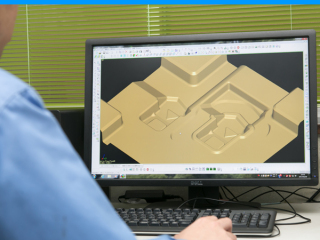
Our expert operators utilize 3D CAD/CAM for state-of-the-art mold design. We propose efficient and high-quality forging mold designs.
Furthermore, preliminary studies using 3D models (made of resin) are also possible.
In mold making, we create optimal high-speed machining data using 3D CAM, achieving a finish that is free of waste and does not require precision polishing, thus enabling short delivery times.
Exhibition booths: 69
Yamako Co., Ltd. Yamako
President and Representative Director
Akihisa Yamamoto
Main products
Hot-forged products and cold-forged products
Hot and cold forged composite product
Machined parts and hand tools
Business content
Yamako Co., Ltd. combines hot forging and cold forging (composite forging) with machining to propose manufacturing that makes the impossible possible. Our strength lies in our composite manufacturing technology, which combines hot and cold forging. With the reliable technology cultivated since our founding, we expand possibilities through a shift in thinking. We provide products with short lead times, low costs, and high quality.
Product and Technology Introduction
From mold design to machining production system for cold-forged products
3D CAD/CAM Design to Mold Manufacturing
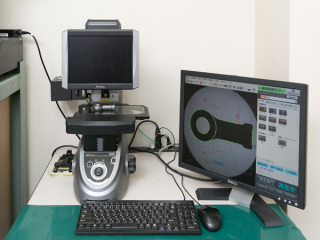
To maintain the precision of products with complex shapes, Yamako's inspection department is equipped with 3D measuring instruments and other inspection tools that can guarantee precision machining. Furthermore, we have the capacity to perform non-destructive testing and strength testing as needed.
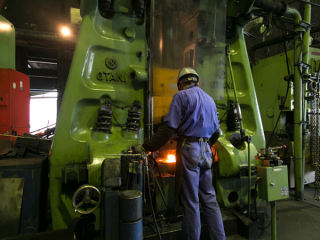
Hot forging and cold forging
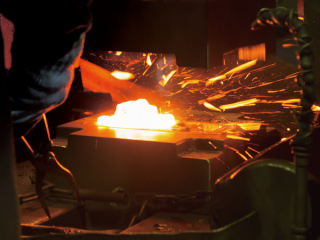
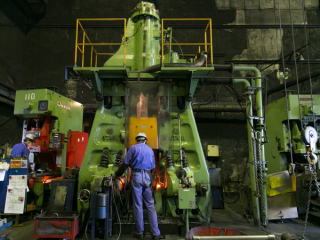
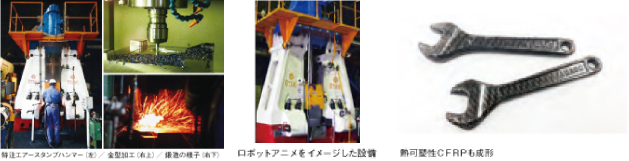
Hot forging involves using an air stamp hammer to rapidly strike a material heated to a high temperature, shaping the product with the skill of a master craftsman. Products forged at high temperatures develop a denser structure, and this refined structure translates into superior strength.
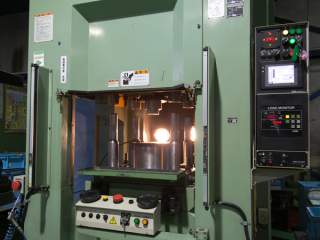
Unlike hot forging, cold forging is a forging process performed at near-room temperature without heating the material. It is characterized by its high precision and the ability to process materials to dimensions and shapes close to those of the finished product. Yamako also specializes in techniques that combine both hot and cold forging.
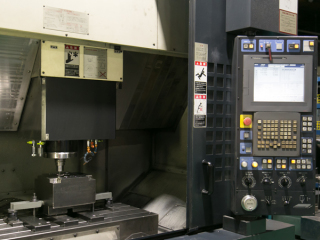
Combining forging with machining makes it possible to forge new materials.
We have equipment capable of not only forging raw materials but also high-precision machining. We have also introduced a 16-ton thread rolling machine so that we can mass-produce special screws and other items. Yamako's greatest strength is its integrated production system that includes machining.
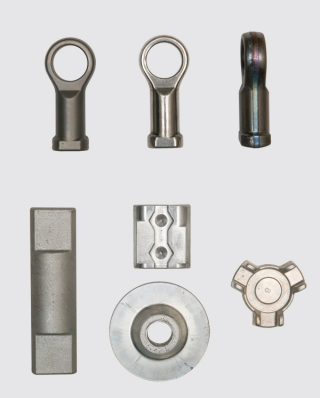
Until now, iron has been the primary material for forged products, and its high strength has led to its use in automobile engines and drivetrain components. In recent years, Yamako has turned its attention to advanced materials and is working on developing next-generation technologies. Moving away from iron forging, Yamako has begun working with titanium (Ti), which is suitable for aircraft and medical equipment, stainless steel (SUS) for home appliances, and aluminum (AL) for next-generation automobiles, anticipating the increasing demand for these materials as forging materials in the future.
Combining hot, cold, and composite forging processes to achieve ultimate precision and propose a "machining-free" solution.
Job description: Improving precision and material handling capabilities, and working with difficult-to-process materials.
The company manufactures forged parts for a wide range of fields, including automobiles, industrial machinery, and railway overhead lines. By internalizing the production of molds at 100%, they have accumulated design and processing technologies, improving the precision of part shapes and their ability to handle new materials. The dimensional tolerance for cold forging, which is performed at near room temperature, is ±0.02 mm. On the other hand, even in hot forging, which allows for the efficient molding of large parts but makes it difficult to achieve high precision, they maintain an accuracy of ±0.04 mm to 0.05 mm. They have successively established forging technologies for difficult-to-process materials such as titanium, Covalion, Inconel, and Hastelloy, and in recent years have also been working on molding CFRP (carbon fiber reinforced plastic).
Strengths: Composite forging achieves both efficiency and precision, while pursuing cost reduction.
Our strength lies in "composite forging," which combines efficient hot forging with cold forging that enables high-precision shaping. Generally, forged parts often undergo machining in subsequent processes to achieve precision.
The company also owns many cutting-type machine tools in-house, and is pursuing cost reduction by increasing the proportion of precision achieved through forging, thereby reducing the number of machining processes.
President Akihisa Yamamoto is looking even further ahead, stating, "Our goal is 'no machining'." They aim to improve the precision of dimensional tolerances and surface roughness even in complex-shaped forged parts, gradually expanding the range of parts that can be used without any machining processes. This will allow them to offer significant cost reductions to their customers.
Human resource development: Manufacturing defects are opportunities to be used for training young employees.
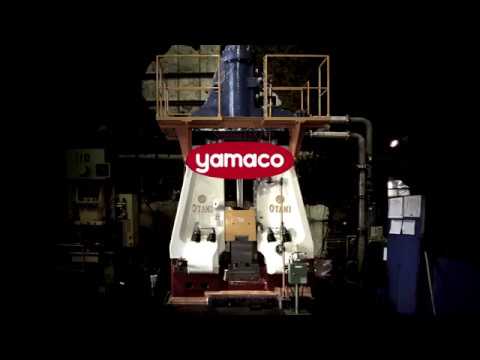
At their monthly quality improvement meetings, the company's basic principle is for everyone to thoroughly consider and analyze "why" and "how." If a problem occurs in the manufacturing process, they basically hold a countermeasure meeting on the same day and come up with a solution within four days. These are not only for customer service, but also a process to deepen the younger employees' understanding of forging. The average age of employees at the company is 35. Yamamoto: "The president takes the opinions of the younger employees into consideration and has introduced a custom-made air stamp hammer (die forging) using red, blue, yellow, and white, inspired by the mechs in robot anime. They are also working to create a factory that breaks away from the conventional image of a forging site."
Future prospects: We will begin developing new areas and are considering establishing a dedicated development building.
The company plans to explore new fields such as aerospace and medical devices through its forging technology for difficult-to-process materials. Having already established both hot and cold forging techniques for Inconel, the company is considering its adoption in aircraft, and has successfully manufactured artificial joint components using Covalion. Furthermore, its thermoplastic CFRP molding technology is attracting attention in the existing automotive sector. Thermoplastic CFRP, which is more suitable for mass production than the thermosetting CFRP currently dominant in Japan, enables three-dimensional molding without internal fiber breakage, and the company has begun proposing this to customers. In addition to manufacturing based on customer requests, the company is also considering establishing a dedicated development building to become a development-oriented company.
Our company history
Founded in 1946 as a manufacturer of hand tools, we established a factory in Higashi-Osaka City, Osaka Prefecture in 1952. We manufacture and sell forged parts and hand tools, and in 1995 we established a factory in Malaysia. Because we challenge ourselves to process not only iron but also all kinds of difficult-to-process materials, companies have come to us asking, "Can you do this?"
Main business activities
Parts manufacturing using hot and cold forging and machining.
Main customers (delivery destinations)
Automotive parts manufacturers, industrial machinery parts manufacturers
Company profile
- Company name
-
Yamako Co., Ltd.
- address
-
4-3-26 Kano, Higashiosaka City, Osaka Prefecture
- representative
-
Akihisa Yamamoto, President and Representative Director
- Founding year/Establishment year
-
1946 / 1952
- telephone number
-
072-965-5621
- FAX number
-
072-965-5513
- Company website
-
http://www.yamaco-forging.co.jp
President Interview (https://note.com/mobio_osaka/n/n7f8d9f9ea5cb)
- capital
-
45,000,000 yen
Acquired ISO9001, JQA-QM8353